Friday, June 17, 2016

Mammoth Cave

Last weekend was a bit of a switcheroo. Isaac went away to visit a few of his friends and my friend Rachel came to Louisville to see me.

She's the kind of friend you are lucky to find once in your life. We met in middle school and have helped each other through the awkward years since then. Together we are satisfied sharing a piano bench, getting dressed up for Sunday brunch or wandering through an old graveyard. But we especially love adventures. Often we joke that we're not having fun unless there's blood. Because between the two of us, someone usually ends up a little dinged up. This time it was me - I slammed the car trunk lid down on my forearm and pinky. All because I was worried about spilling a glass of water, which I did end up spilling by the way. Luckily the force was perfectly distributed so that my pinky didn't get too bashed up - just one gash and enough bruising to brag about.

Even though we see less of each other now than we did during our school day, we try to make the most of the time we can share. And so Saturday morning we drove two hours south of Louisville, down highway 65 as it cuts through wide spreads of green and tree-covered knolls. Destination: Mammoth Cave.


Mammoth Cave is the longest known cave system in the world. I like that word "known" because it reminds us that there are still lots that we humans don't know and haven't figured out about what's around us. Each year volunteers continue to explore the far-reaching fingers of Mammoth Cave, mapping out more and more of this unique underground realm.

The park is over 50,000 acres and as you drive through it to reach the central hub (visitor's center, parking lots, even a hotel!) it just feels like driving through the sticks. I managed to avoid squishing a long, dark snake as it lay sunbathing on the road, and a few times we questioned if we were going the right way just because of the sheer nothingness around.

Mammoth Cave is national park, with plenty of hiking trails and kayaking on the surface to keep you occupied besides what lies beneath. In order to view the caves, you must sign up for one of the many tours offered. Our tour was called "Domes and Dripstones", two hours long and starting at the first available time, 8:45. Our early bird spirit paid off too. Each tour has a cap of 120 people, which is quite a bit if you can imagine the sounds of 120 voices and 240 feet shuffling in the cave around you. We grinned when the ranger mentioned that there were only about 50 people in our group.

We met our tour group beneath a roofed shelter where the park ranger shared basic rules like no eating, no smoking, no restrooms in the cave. Then we boarded two hunter green buses for the short drive to the cave entrance.


There are several openings to enter the cave, one within walking distance of the park's hub. Our tour began at "the new entrance", a cement box hunched on the forest floor with a metal door and a single glowing light. I couldn't believe this was the prelude to our underground adventure. It looks like the portal in some fantasy movie leading you to another world.


What came next was one of the most uncomfortable five minutes of my life.

During our two hour drive that mornin, our excitement built about the upcoming adventure. We talked about spelunking, the hobby of cave exploration. Rachel had previously done a spelunking tour with her family somewhere in Canada, and shared that while it was fun, she had no desire to repeat it. Without ever trying it, I second her feelings. Some of the most frightful bits from books and movies I have experienced involve being confined underground. Something about it is so unnatural, so instinctively repulsive. People dream of having wings, of flying high in the air. No one dreams of groping underground in the darkness. At least no one I know.

We walked through the new entrance's metal doorway single file, Rachel first and then me. A descending staircase, with orangish bulbs periodically spaced providing just enough light to cast an eerie hue and deep shadows along the narrow passageway. And then we met the cave crickets. Clinging to the surfaces on all sides of us, alarmingly close, mere inches away, antennae waving their flesh-tingling greetings as we skittered down ever further. I'm not terribly afraid of bugs, but I also didn't foresee having so many creepy crawlies that close to my face.

Of course a cave tour must begin with a descent. After about 20 steps down, the cement tunnel as replaced with undulating waves and wrinkles of sandstone and then limestone. Our path was still narrow, the air cool and damp as our footsteps echoed off of the metal staircase, folding back and forth as it led us down through a dome, a geological formation like an upright tube.

Below on the left is a shot leaning over the stairway's rail and looking down. On the right is a shot looking straight ahead as we continue to descend, at times squeezing between chunks of rock.


Down we went. Even though my senses were tingling, telling me that nothing about this feels natural, I couldn't help but be in wonder. The caves were more vivid than any movie, more impenetrable and beautiful than anything man has made.


After the initial descent, things got more comfortable. The cave crickets only creep around near the surface, and knowing that is all the encouragement needed to keep going down.


The passageways changed as we walked along, smooth then jagged, wide chambers then narrow slips.


Occasionally our group gathered, settling onto benches arranged in some of the larger chambers. The park ranger shared history about the cave itself and man's dealings with it. I'll share just a few of the highlights.

Before coming to Kentucky, I had heard about the bluegrass. But since living here, limestone seems like the more popular subject. It gives the bourbon here its unique Kentuckian taste, and water running through it is what carved out these caves. The soft limestone is a remnant from an era before the dinosaurs, when this land was submerged, the bed of a shallow sea located south of the equator.

Several people explored the caves before it became a national park (a process that began thanks to Teddy in the 1920's but wasn't dedicated until the 1940's). In the late 19th century a doctor kept tuberculosis patients quarantined in the caves, hoping to find a cure amidst the cool, wet and dark climate. One reckless man named George Morrison wandered around beneath the surface with a cigar and handfuls of dynamite, blasting his way through and discovering some of the cave's most popular chambers and features.


Below you can see the difference between the sandstone and limestone. There's the jagged and flaky limestone that's fallen away to reveal the smooth layer of sandstone above.
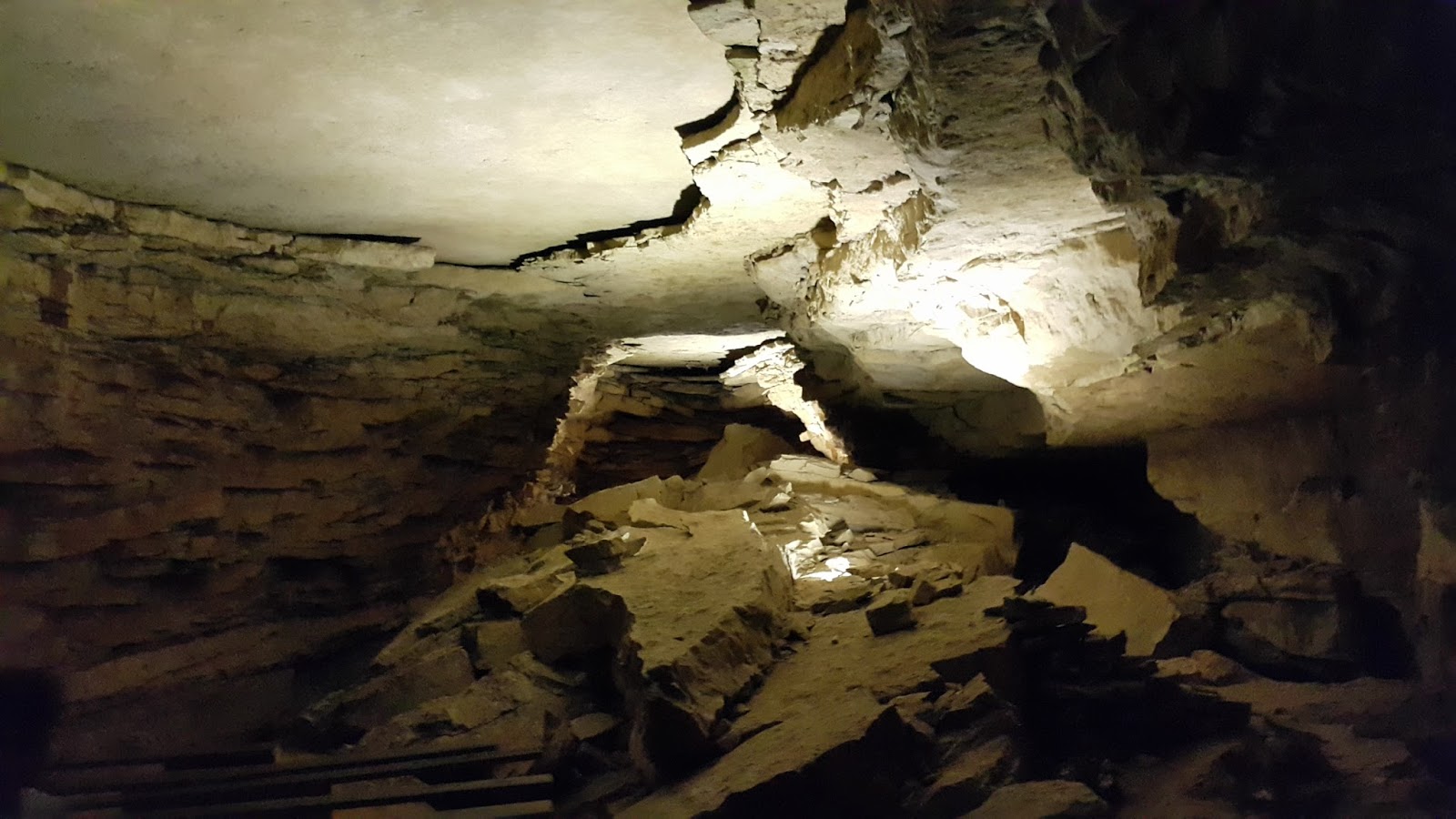

Looking through these pictures, they don't seem to convey the magnitude of the place. But I hope you can still feel some of its beauty and vastness.


And where there is water, eerily beautiful structures like stalactites and stalagmites form. Before becoming a national park, when the caves (or the land they rest beneath) were owned by private parties, people were already making money off of cave tours. Visitors were allowed to carve their initials into the stone and even break off some piece they fancied to take home as a souvenir.

Below are images from a section of the cave called Frozen Niagara. It resembles a waterfall stuck in time.

This area was one of those discovered by that daring man with sticks of dynamite.


Have you seen enough of the caves yet? We hadn't. We continued snapping pictures as the park ranger bringing up the rear of our group urged us forward. As a woman just ahead mumbled to her husband that "They didn't mention it was just a bunch of rocks on Trip Advisor".

It was stunning. Afterwards, we ate our picnic lunch and glanced over the park brochure, pausing to examine its cave map. We skipped around the tiny printed words searching for the places our park ranger had named during the tour. On our two hour walk through the caves, we felt the vastness of that underground realm. Looking at this map renewed the feeling again, when we realized that our entire tour covered only one tiny bit of the known caves. I put a red box below around the area we explored. We were overwhelmed by our taste of the caves, yet there is so much more down there.


After lunch, we took a hiking trail through the woods to the aptly named Green River which runs through the park. The ranger mentioned before that there are not many creeks in the park; the water drains underground, sliding its way down until it exits the caves and joins the Green River. We stumbled upon one of the places where the cave opens up, spilling its calming trickle of water out towards the river.


It's a special treat to have a magical place like this so close to where we live. I can't wait to visit the caves again with Isaac. I'll definitely bring along my bright green rain coat again to protect me from the cave crickets.

Friday, June 10, 2016

A bit about Korean Language

Although we now live in Kentucky, I'm still trying to learn more Korean. And even though daily tasks like buying groceries or figuring out what the buttons on the washing machine mean no longer help me towards this goal, bit by bit my Korean is improving.

I could go on a while about different language learning methods, but what I'm doing now is pretty fun and helpful. During grade school, most people experience the boredom that is memorizing vocabulary. You sit and stare at a list of twenty words and their meanings and try to make them stick in your mind. But hands-on experience makes learning so much more fun. So lately I just try to study Korean words and grammar in their natural context.

So here's what I study with these days. A blank notebook for writing, a Korean-English dictionary app on my cell phone and a Korean language novel - Harry Potter and the Sorcerer's Stone Part 1.


I can't help but be reminded of my elementary education training. If someone were to assess my reading level, they would definitely say that this text is too hard for me and give me something more simple. Yet having read the Harry Potter series three times through, it is a story I know well. So as I struggle through the Korean edition, I can focus completely on just understanding the words, not the story. I read a sentence out loud, try to make sense of it, then take a closer look at any parts I don't understand. Unfamiliar words and grammar are written down in my notebook. I also write down particularly hard or long sentences in order to dissect them further - using notes and arrows and circles to clarify its different parts. Then I read on to the next sentence!

I don't memorize every unfamiliar word or grammar point as I go, but as I continue reading, these strangers reappear again and again, until finally they stick in my mind. It reminds me so much of what I learned about teaching new readers in elementary schools, or new learners of all kinds for that mater. "Accept approximations" our professors always said. We can't learn or remember 100% the first time through, but little by little we pick up bits along the way, and those small improvements are worth celebrating.


As I've studied Korean, I've learned some interesting bits about the language and particular words that I thought are worth sharing.


The Korean alphabet, hangul, is praised by linguists as one of the most efficient and scientific of all languages. It was created about 600 years ago during the rule of King Sejong, who now sits immortalized by the huge statue shown above located in the heart of Seoul. At the time, there was no written alphabet for the Korean language. Scholars used Chinese characters, but many common people were illiterate. There was simply no system to record the thoughts and expressions of the Korean language people spoke. And so Hangul was born.

So what makes it so special? I'll try my best to point out some things.

If you look at Korean writing, it can fit within a series of boxes. Like the writing on the statue above says 세종대왕. You could draw a box around each grouping of letters, kind of like this [세] [종] [대] [왕]. Each box is one spoken syllable. So with words in English (and many other languages) you can't tell how many syllables a word will be by just looking at it. "Hello" and "point" both have five letters, yet the number of syllables when spoken is different.

There are no capitals and lowercase letters in hangul. Can you imagine being a student and never having to worry about which words to capitalize?! The Korean language has other ways to show you that a word is special (like the name of a person or city), similar to what a capital letter does in English. And who needs to capitalize the first letter of a sentence anyways, periods tell us where sentences end and begin.


(We took the picture above at a museum exhibit teaching about the origin of hangul. It's located underground, and you enter it through an opening on the backside of the golden King Sejong statue. Below on the right was me trying to write hangul with a calligraphy brush in the same museum.)

I wish I could better pinpoint what makes hangul so special, beloved and admired by language professionals. I can say from experience that it is incredibly easy to learn. Most people can learn to read the Korean alphabet in just a couple of hours. I learned it easily during high school by doodling in the margins of class notes.

Written Korean does not use apostrophes (') and rarely uses commas. Reading with such punctuation helps you to identify specific ideas and split a sentence into different thoughts. In the Korean language there are tags you put at the end of words that convey the same meaning, but it takes some getting used to!

Every now and then, I come across a word in Korean that sticks out because I can't think of a direct English translation. Right now, I can only think of two, but they are my favorites so far.

그저께 (geu-jeo-kke) means "the day before yesterday".

모레 (mo-re) means "the day after tomorrow".

I just think it is so neat that there are specific words for these days!

So those are my fun tidbits about the Korean language and my self-studying. I hope this post didn't seem too dull or rambling. I just wanted to share a little bit of what I've been learning.

Saturday, June 4, 2016

Frankfort and Buffalo Trace Distillery

When it comes to outings, I think the method Isaac and I use works well for us. I research, throw out the occasional gauging question to test his interest and thoughts, then off we go. Last Saturday morning we were sitting around when this happened. We are at that stage where we are most comfortable and happy just hanging out together at home. But because it was Memorial Day weekend, it seemed like we should do something special. And so I asked, "Hey, you wanna visit a bourbon distillery today? It's about an hour away and the tour's free." I could already tell his interest was peaked. "It's where they make Blanton's and Pappy Van Winkle." A short time later, we changed out of our pajamas and were on our way to Buffalo Trace Distillery.


We have passed its brown sign on interstate 64 a few times while driving between Lexington and Louisville. The distillery is located just north of downtown Frankfort, so we figured we would grab a bite to eat as we pass through, giving us a chance to see the state's capital as well.

Frankfort was a huge surprise to us both. You get off the interstate and onto a highway that loops around the top of the city. I don't guess it's considered mountainous, but this area has lovely terrain that reminds me of the mountains - you drive through sections of cut rock and there are valleys and high hills all around. You can see what I mean below, this is a shot of highway 127 that swings around Frankfort.


Very beautiful and remote feeling. Continuing on, we cross the Kentucky River which runs through the city's heart. Looking at the picture below, I wouldn't have guessed that this winds through a state's capital city.


And then we arrived at a stoplight. According to our map, we were in the heart of Frankfort. Boy, is it charming. Surprisingly small and oozing with that old fashioned American town feeling.


We will have to go back and explore some time, but other than the state house, it doesn't seem like there's much to be seen. After scarfing down a quesadilla and enchilada at record speed, we took off for the main attraction.

Buffalo Trace Distillery prides itself on being the longest continuously running bourbon distillery in the world. It opened in 1786 and was one of the lucky few given permission by the US government to continue operating during prohibition. They offer several free tours of the grounds and facilities. We went on their standard Trace Tour which offers a brief overview of the distillery, the bourbon making process and a taste testing.

Upon arriving, Isaac and I were both surprised at how beautiful the grounds were. It's not that we had any expectations for what it would look like, our decision was too spontaneous for that. I would expect a winery to be beautiful - with endless rows of grape vines - but a distillery doesn't carry the same romance. Never ending seas of corn and grains perhaps?

Anyways, the entrance to Buffalo Trace looked like a country club. Brilliant green Kentucky bluegrass, sharp landscaping, old metal and brick structures offset against a blue sky.

There is a two story gift shop, bar and lounge where you can kill time browsing, drinking and learning a little more about the place.

Below is an enlarged copy of a prescription written for bourbon during the prohibition era. It seems like there were a lot of sickly people needing the stuff, our tour guide told us that 6 million prescriptions were written for bourbon in Kentucky alone during that time.


There was also a long list of all of the distilleries in Kentucky. Only a handful of the names survived the Prohibition Era. 


When Prohibition ended, there was a spike in demand for bourbon and the distillery was in a hurry to expand. This is the reason the building shown below was built out of metal, to get it up as quickly as possible. This place, known as warehouse H, is where Blanton's is made, a popular and nice quality bourbon.


If you just walk near these buildings, the smell of bourbon permeates the air. The tour guide said he liked to think about the shadowy coating on the outside of the buildings as bourbon patina, not mold.


Walking inside this warehouse, it looked about like you would imagine. Long rows of wooden barrels stacked on top of each other, with the finer quality products on the bottom floors. It is dark, cool and of course smells like bourbon. We were breathing in "the angel's share" of the alcohol.


Doesn't Isaac look like the entrepreneur of some new start up company?

He was reluctant to leave this place.


Next stop was a bottling area where Blanton's bourbon is put into glass bottles, corked, sealed with wax and labeled.


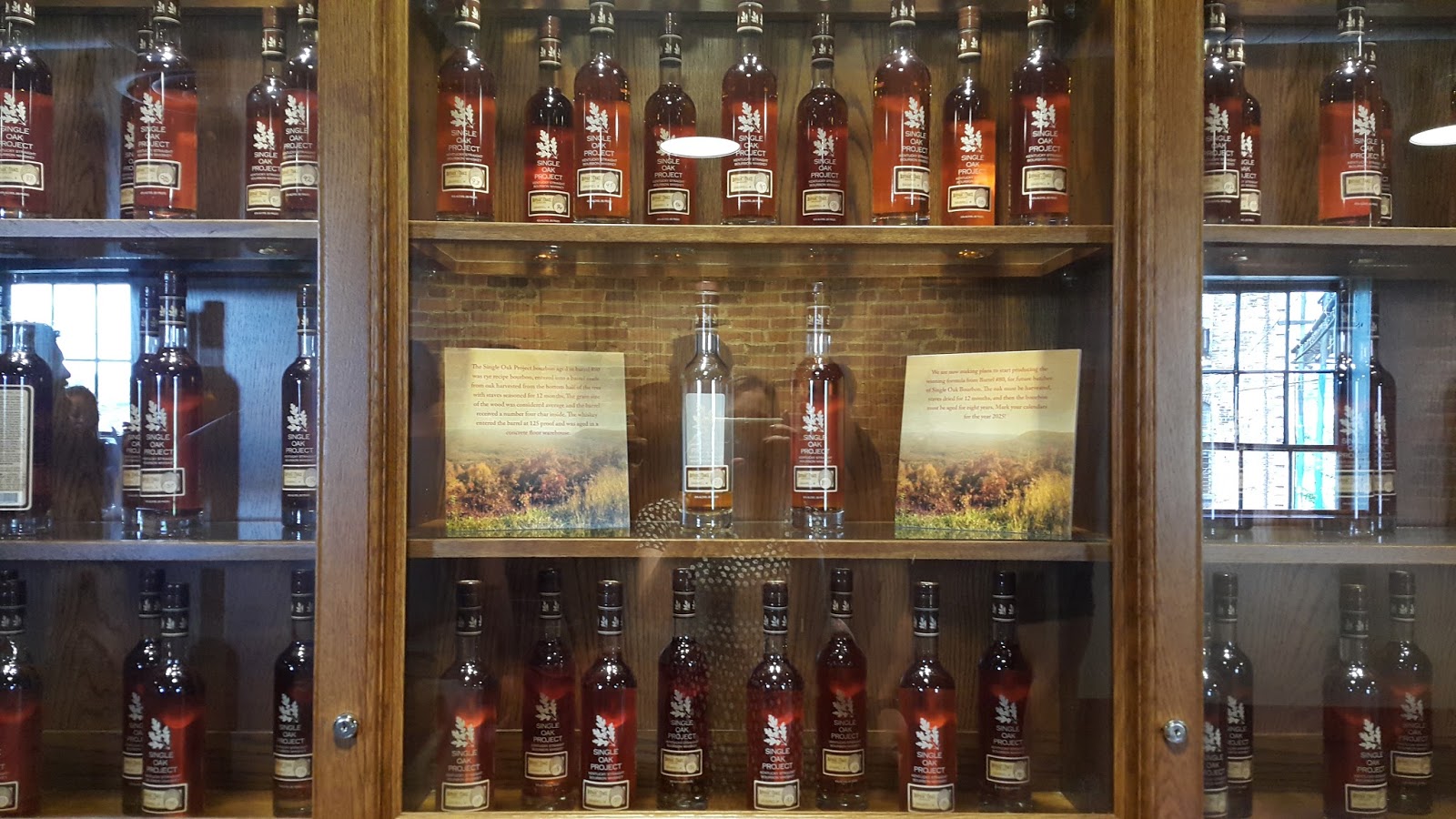
Above are bottles from their recent Single Oak Project. This was a neat and large scale experiment in which they created 192 unique barrels of bourbon, varying different factors in the bourbon making process like age of oak tree, growing location of oak tree, degree of wood charring and grain ratio. All 192 different recipes were taste-tested and a winning barrel was announced. They are now in the process of recreating winning barrel #80 and will have it ready to sell in 2025.

That's something I never considered about making spirits like this, the amount of time it takes. Our tour guide said that in recent years, there has been a huge spike in demand for bourbon. But for distilleries, they can't immediately crank up production to meet the increased appetites. It takes many years - anywhere from 8 to 23 at this distillery - to produce a product. They have increased production now, buying up a nearby farm and building many new warehouses, but perhaps by the time the bourbon is ready in a decade or two, demand will have slowed down again.

One of this distillery's most coveted products is Pappy Van Winkle bourbon. Usually liquor sellers these days hold lotteries to determine which customers are given the privilege to buy a bottle from the short supply they receive. Our tour guide said just eight years ago, they had bottles of it available in their gift shop to buy. Now, it seems your best chance at buying it is online at ridiculously inflated prices.


We finished our tour with a complimentary taste-testing. Of course they didn't offer their higher end products, but it was still fun to try and pretend like we're liquor experts. Below from left to right is vodka, white dog (unaged bourbon, the same mix just not stored in a barrel for years), an 8 and then 10 year bourbon. I knew I didn't like vodka, and had suspicions I'd feel the same way about moonshine. I just sort of kissed all four of the liquids, just enough to feel the burn, but I'm glad I tried at least. 


Next came the much more enjoyable part, dessert. Bourbon balls, chocolates with a bourbon flavored center, and bourbon cream which they recommend serving with root beer. The combination was dangerously delicious, like a grown up root beer float.


This was the end of our tour, but we still wanted to walk around a little bit, and explore a few buildings on a map we had received. The grounds are really beautiful, like a park with old brick and metal pipes popping up all around.


Below was originally a guest house, but now serves as the president's office. The house and other buildings nearby are built in a style introduced by early settlers. I wish I could remember which European countries the map mentioned, because the style is super cute! If you recognize it, please let me know!


This large building is used for special events. I imagine it doesn't get much more Kentuckian than to get married at a bourbon distillery. They were setting up for a wedding when we peeked in the windows.


As we walked around this pretty scenery, we wondered how other distilleries on the Bourbon Trail would compare. There are many such places in Kentucky, and some people make a vacation of visiting them all. We both agreed that it would be hard to beat this place - its beauty, the prestige of its products, the price! In South Korea, we tried to make the most of our surroundings by trying out its many delicious restaurants. It seems like making the most of living in Kentucky might involve touring its many bourbon distilleries.